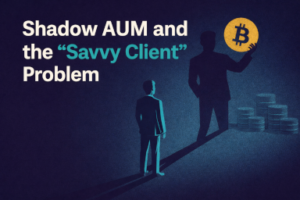
Shadow AUM and the “Savvy Client” Problem
Why DIY Crypto Is a Structural Risk for RIAs
The Quick Take:
When a client manages their own crypto, it can feel operationally convenient. In practice, it creates Shadow AUM — material assets outside your custody, reporting, and supervision framework. That gap introduces fiduciary blind spots and regulatory ambiguity. Keychain Asset Management provides a sub-advisory structure that brings digital assets into institutional oversight.
The Structural Problem: Advising on a Partial Balance Sheet
When clients hold significant digital assets outside the advisory relationship, you are advising on incomplete data. This is not merely a reporting issue — it distorts the advisory process itself:
- Incomplete Risk Modeling: Stress-testing and liquidity planning are compromised if a meaningful portion of net worth is excluded from portfolio analytics.
- Tax and Estate Gaps: Digital asset tax lots are frequently unverifiable. Beneficiary designations and key access procedures are rarely aligned with estate documents.
- The Bottom Line: If it is not supervised within a documented framework, it is not fully integrated into fiduciary oversight. That is approximation — not comprehensive wealth management.
Regulatory Risk: Ambiguity Under the Custody Rule
SEC Rule 206(4)-2 defines custody narrowly. However, examinations increasingly focus on the broader scope of advice, documentation, and supervision. When an advisor discusses allocation strategy for off-platform crypto, incorporates those assets into planning assumptions, or provides informal guidance, the boundaries of responsibility can become blurred during examination.
This is not about technical custody status; it is about defensibility. Ambiguity during a regulatory review is costly in time, legal expense, and reputational risk. A structured oversight framework reduces that ambiguity.
The Bankruptcy Reality Clients Often Miss
In multiple recent exchange failures, customers were treated as general unsecured creditors in bankruptcy proceedings — a distinction most investors did not anticipate. Many clients assume assets are segregated or safe because they are with a large platform; those assumptions have proven unreliable in stressed conditions. If a client loses 20–30% of net worth due to counterparty failure, the advisor is left explaining why that exposure remained outside an institutional custody structure.
A Common Scenario: The $5M Blind Spot
- Client Net Worth: $25M
- Managed by RIA: $20M
- Self-Managed Crypto: $5M (Retail exchange + hardware wallet)
The Exposure: The advisor cannot independently verify holdings, validate custody controls, or stress-test liquidity. If that exposure fails operationally, 20% of the client’s wealth is impaired outside the advisory framework. From a fiduciary risk-management perspective, that is a material oversight blind spot.
This Is Also a Strategic Opportunity
Digital assets are now common in high-net-worth portfolios and increasingly concentrated among next-generation beneficiaries. Institutionalizing crypto oversight allows RIAs to:
- Capture AUM: Convert shadow assets into supervised, billable mandates.
- Strengthen Retention: Deepen relationships with digitally native heirs.
- Enhance Differentiation: Demonstrate technical fluency and governance discipline.
- Improve Enterprise Risk Posture: Reduce regulatory and operational ambiguity.
The Institutional Solution: Keychain Sub-Advisory
Keychain Asset Management operates as a specialized digital asset sub-advisor to RIAs. We do not compete for your client relationship; we strengthen it. Through segregated accounts held at a Qualified Custodian (BitGo), we provide:
- Institutionalized Custody: Migration from retail exchanges and ad hoc self-custody into multi-signature cold storage with defined governance controls.
- Restored Visibility: Integration of digital assets into formal reporting, allocation modeling, and documented strategy.
- Regulatory Clarity: A structured oversight framework aligned with Custody Rule considerations and examination defensibility.
- Fiduciary Integration: Risk-managed, tax-aware, and estate-aligned digital asset portfolios.
Institutionalizing the “Savvy Client”
The most sophisticated firms are not avoiding digital assets; they are recognizing unmanaged exposure and bringing it into a compliant fiduciary framework. If your firm currently allows material crypto holdings to remain outside custody and reporting, the question is not whether risk exists. The question is whether it is supervised, documented, and defensible.
Explore a Sub-Advisory Framework We offer confidential consultations to evaluate how your firm currently addresses client-held digital assets and where structural blind spots may exist. Let’s bring digital assets into a structured, defensible fiduciary framework.
Schedule a Sub-Advisory Consultation
About the Author
Brent Pearson is the Principal, Chief Compliance Officer, and Investment Adviser Representative at Keychain Asset Management. With over a decade of hands‑on experience in the cryptocurrency market and a background in FinTech software development, Brent brings a rare combination of technological acumen and financial insight to his work. He is the author of ‘Understanding Bitcoin and Protecting Your Assets with Crypto: How to Secure Your Wealth in Any Financial Climate‘, reflecting his deep commitment to educating and empowering investors. Brent founded Keychain Asset Management to bridge the gap between traditional wealth management and the evolving digital economy, and he upholds a fiduciary standard to ensure every piece of advice is unbiased and in the client’s best interest.