Why your financial plan needs a fiduciary approach to digital assets
In the digital asset market, uncertainty is constant. But for serious investors, the greatest risk isn’t volatility—it’s unmanaged exposure.
Many investors believe they are “diversified” because they hold both traditional assets and crypto. In reality, they are often running two separate portfolios: one carefully managed, and one operating without structured oversight.
When it comes to your wealth, your most important asset isn’t a token or a wallet. It’s a fiduciary relationship that brings structure, discipline, and accountability to your entire financial picture.
The “Compliant Control” Framework
At Keychain Asset Management, we do not treat digital assets as a product category. We manage them within a disciplined framework we call Compliant Control, built on three non-negotiable pillars:
Regulated Advice
As an Oregon-registered RIA, we operate under a fiduciary standard. Every recommendation is made in your best interest—not driven by commissions, referrals, or speculation.
Institutional Custody
We eliminate exchange risk by using qualified third-party custodians such as BitGo (https://www.bitgo.com/). Your assets remain independently held, auditable, and secured with institutional-grade infrastructure.
Risk-Defined Construction
Digital assets are not a side bet. We treat them as a defined allocation within your total portfolio, governed by position sizing, correlation analysis, and disciplined rebalancing.
Integration vs. Hidden Risk
Many investors maintain crypto holdings outside their financial plan—positions that are rarely tracked, rarely rebalanced, and often misunderstood. This creates a dangerous blind spot.
The Scenario: The 5% Volatility Trap
Consider a client with a traditional $1M 60/40 portfolio. They add a seemingly small $50,000 (5%) position in crypto. During certain market conditions, that 5% “sleeve” can account for over 30% of the total portfolio’s daily variance.
Without an integrated view, you aren’t just holding crypto—you may be running a portfolio with significantly more risk than you intended. During periods of tightening liquidity, digital assets often behave like high-beta risk assets, amplifying drawdowns rather than diversifying them.
We address this by:
– Quantifying cross-asset correlations
– Stress-testing drawdowns across market regimes
– Enforcing allocation bands through systematic rebalancing to prevent unintended allocation drift
Your digital assets should align with your retirement timeline, tax strategy, and estate plan—not operate in isolation.
Where Allocation Breaks Down
A common misconception is that allocation size equals risk. In practice, that assumption often fails. A high-volatility asset can dominate total portfolio risk—even if the position size is modest.
“This is where most portfolios fail. Not because of the asset—but because of how the risk is managed.”
At Keychain, we ensure that risk contribution remains aligned with intent.
Our objective is simple:
A 5% allocation should behave like 5% of your risk—not 30%.
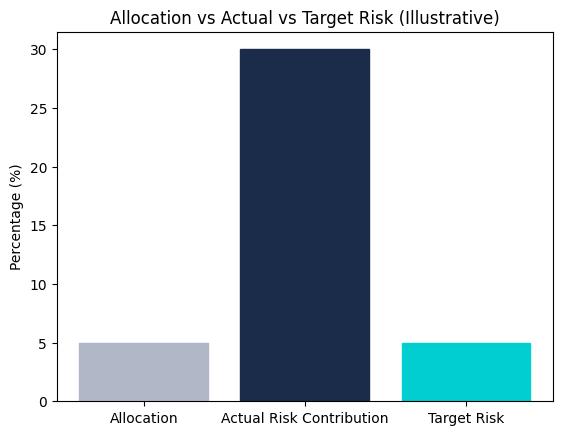
Illustrative example: Without active risk management, a small allocation to a high-volatility asset can dominate total portfolio risk. A disciplined portfolio maintains alignment between allocation and risk contribution.
By modeling how digital assets interact with your broader holdings, we implement controls to maintain your target volatility. This reduces exposure to sequence-of-returns risk, which can permanently impair long-term wealth if left unmanaged during critical withdrawal phases.
Bridging the Fiduciary Gap
You shouldn’t have to choose between the innovation of digital assets and the discipline of traditional finance.
By applying fiduciary standards, institutional custody, and portfolio-level risk management, we bring structure to an area of the market that is too often driven by fragmentation.
Your financial plan is a living system. It requires an advisor who understands where markets are going—but remains grounded in the principles that protect capital over time.
Is Your Crypto Exposure Working for You—or Against You?
If your digital assets aren’t fully integrated into your financial plan, you may be taking on more risk than you realize.
Schedule an Integrated Portfolio Risk Review to understand:
– How your crypto exposure affects total portfolio volatility
– Whether your allocation aligns with long-term liquidity needs
– Where hidden vulnerabilities exist in custody, tax, or structure
About the Author
Brent Pearson is the Principal, Chief Compliance Officer, and Investment Adviser Representative at Keychain Asset Management. With over a decade of hands‑on experience in the cryptocurrency market and a background in FinTech software development, Brent brings a rare combination of technological acumen and financial insight to his work. He is the author of ‘Understanding Bitcoin and Protecting Your Assets with Crypto: How to Secure Your Wealth in Any Financial Climate‘, reflecting his deep commitment to educating and empowering investors. Brent founded Keychain Asset Management to bridge the gap between traditional wealth management and the evolving digital economy, and he upholds a fiduciary standard to ensure every piece of advice is unbiased and in the client’s best interest.
Disclaimer: Investing involves risk, including possible loss of principal. Past performance is not indicative of future results. Keychain Asset Management is a Registered Investment Adviser (RIA). All investments are subject to market conditions.